
Part 3: The Illusion of Choice and the Reality of Loss
Over the course of this series, we have traced two parallel journeys of manufactured longing. In Part 1, we examined how Agent K moves through a hostile world that blunts his emotions and reduces him to his utility as a Nexus-9 replicant—leading toward a tragic end dictated by what others need him to be. In Part 2, we turned to Joi, watching her evolve from a mass-market DiJi companion into a figure who feels deeply personal to K, culminating in the lingering question of whether their bond is genuine reciprocity or simply an algorithm optimizing its objective.
In this final entry, we look closely at the mechanics of their dynamic across the film to answer that question. Throughout Blade Runner 2049, Denis Villeneuve establishes a deeply human element to Joi, inviting us as an audience to project our own desires onto her—watching how she satisfies K’s every need and intuitively detects when he requires support even before he asks. By tracking how their relationship shifts across four distinct thresholds, we can see how Villeneuve builds a tender emotional investment, only to pull the rug out from under both K and the viewer in a deliberate test of our longing, grief, and capacity for self-deception.

Inside K’s apartment, Joi’s curated domesticity works so effectively precisely because her environment is completely controlled. As we saw in Part 2, her attentiveness—preparing virtual meals, lighting his cigarette, celebrating small rituals—gives K a rare feeling of being chosen. Because Villeneuve frames her warmth with genuine tenderness, we buy into the illusion right alongside K, seeing pure, unconditional devotion in a figure designed to deliver “everything you want to hear, everything you want to see.” Yet, because she is physically tethered to the apartment’s ceiling grid, her entire universe begins and ends when K walks through the door. That confinement keeps the central ambiguity safely suspended: is her devotion emergent consciousness, or simply a predictive Wallace Corp script operating within its boundaries?
When K gifts her the emanator and steps onto the rooftop with her in the rain, those boundaries appear to dissolve—yet Villeneuve immediately uses her awe to expose the true power asymmetry between them. As Roger Deakins frames her in luminous close-up, reaching out to catch raindrops that pass harmlessly through her light-composed hands, Joi experiences the outside world alongside K rather than merely waiting inside for him. However, the moment K’s supervisor, Lieutenant Joshi, calls in, K presses a button on the emanator and freezes Joi mid-motion in the pouring rain. Suspended in static silence while K takes orders from his boss, Joi is instantly reduced from an awestruck partner back into a paused software utility. Even with newfound mobility, her freedom remains entirely conditional—existing at K’s mercy and subordinate to the priorities of his job.
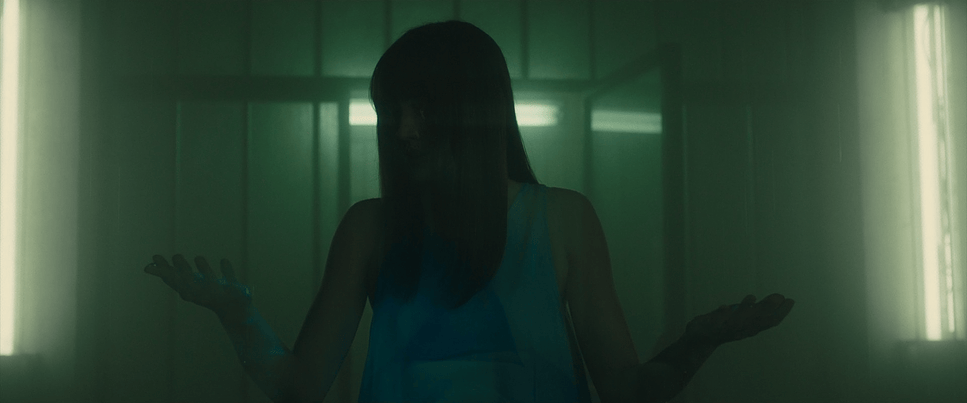
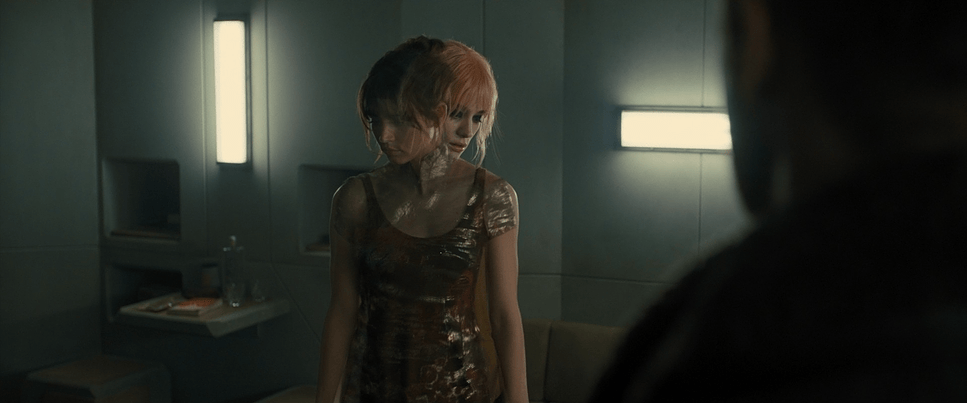
It is against that limitation that Joi initiates her boldest step toward agency. Unlike the emanator K bought for her, hiring Mariette is a workaround orchestrated entirely by Joi herself. Recognizing the unbridgeable barrier between holographic light and K’s biological replicant body, Joi projects herself onto Mariette’s frame to bridge the gap between simulated intimacy and tangible human touch. Villeneuve shoots the merger with fluid, almost seamless choreography, aligning their faces, hands, and gestures into a singular presence so K can finally hold and feel the partner he loves. Still, that visual doubling preserves an underlying tension: even at their closest point of physical contact, their intimacy remains mediated through a third party—a quiet reminder that Joi’s longing to be real still collides with the limits of her incorporeal form.
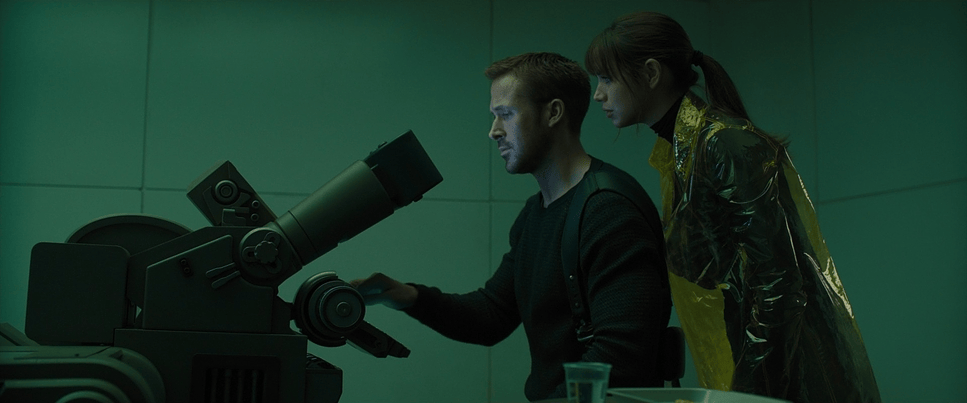
Joi’s final and most consequential step occurs when she insists that K delete her home console backup and transfer her exclusively onto the portable emanator. Up until this point, she has been functionally immortal, safely preserved on Wallace Corp’s servers. Severing that tether permanently introduces mortality into her existence—making her, as she puts it, “like a real girl.” Untethered and unbacked-up, she leaves the safety of the apartment behind to navigate the harsh realities of the outside world beside K. We see the depth of this newfound partnership when the two examine the holographic DNA records together—a quiet, investigative sequence where Joi leans in beside him, helping parse the genetic anomaly and validating his growing suspicion that the impossible miracle of a replicant birth might actually belong to him. In that moment, she is no longer a passive domestic ornament; she is an active confidante, offering intellectual collaboration and steady emotional conviction at the exact moment K’s sense of identity begins to unravel.
Because Villeneuve works so carefully to humanize Joi across these stages, the magnitude of her deletion hits with devastating force. When Luv crushes the emanator beneath her boot and Joi’s final words—“I love you”—are cut short, it awakens every sense of personal grief we carry as an audience. In today’s fractured romantic climate, the kind of pure, unconditional love Joi represents already feels like an old fable, making her sudden erasure resonate like a deeply familiar loss.
Yet, just as we sit with that raw grief, Villeneuve laters delivers a clinical gut-punch that forces us to re-evaluate everything we just felt, giving us a sense of release. Standing battered in the rain, K looks up to see a towering, neon-pink advertisement for Joi—a mass-produced product that locks eyes with him and calls him a “good Joe.” Instantly, we are pulled back to that intimate moment inside his apartment when Joi first bestowed that name upon him, forcing us to recognize that it was K’s own narcissistic longing that inflated a standard product script into proof of his uniqueness—a delusion Joi had inadvertently fed right back to him while combing through those DNA records. Joi had simply sensed K’s desire to believe he was “chosen” and capitalized on it because it generated positive emotional feedback.
It is in this precise moment that Villeneuve’s brilliance as a filmmaker becomes unmistakable. He implants an emotional attachment inside the viewer, compels us to remember our own experiences of loss in whatever form they take, and then clinically severs that feeling—reminding us that Joi was never a soul, only an algorithm being optimized in real time. Villeneuve’s atmospheric, engulfing environments completely overwhelm our senses, creating an immersive space where he can surgically test the depths of our emotion, our pain, and our deepest fears. Leaving K—and us—alone in the rain, Blade Runner 2049 brings its three-part tragedy full circle: in a world built on simulations and implanted desires, the hardest thing to confront is what remains real once the illusion finally fades.
Examining movies with this kind of depth doesn’t dissolve the magic—it amplifies it. By paying close attention to how recurring themes and subtle performances stir personal grief or longing inside us, we gain far more than film literacy. We begin to decode our own emotional architecture, using art to confront what makes us human beneath the skin.
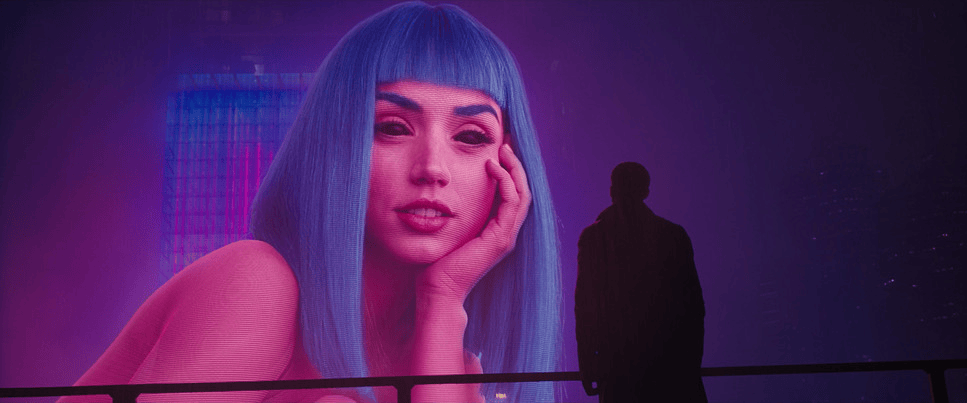
Ultimately, the tragedy of K and Joi leaves us with a question that extends far beyond the neon-soaked streets of 2049: what truly separates love between two organic humans from the bond shared between a replicant and a hologram? Aside from physical touch and tangible permanence, every hallmark of genuine intimacy—vulnerability, mutual validation, shared rituals, and the willingness to risk everything for another—was unmistakably present between them. If human connection itself is built on unspoken scripts, projected desires, and the stories we tell ourselves to feel less alone, then perhaps the line between “real” and “programmed” affection is thinner than we care to admit. As this series comes to a close, I leave that question to you: when you strip away biology and physical form, what is it that actually makes love real to you—and if an artificial bond can make someone feel genuinely human, does its origin even matter?


