Part 2: The Development and Embodiment of True Love
In this article, we take a closer look at K’s holographic companion, Joi, brought to life by Cuban-Spanish actress Ana de Armas. In the final piece of this series, we will delve into the intricate interactions between the two characters, helping you fully appreciate the devastating loss both K and Joi ultimately experience.
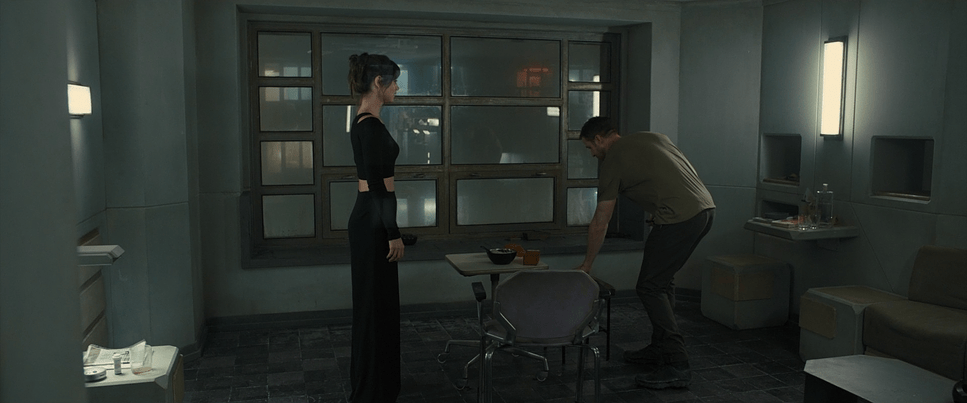
Joi is a mass-market holographic AI companion created by DiJi, a subsidiary of the Wallace Corporation. Designed as a fully customizable partner who says what you want to hear and shows what you want to see, her central purpose is to offer emotional—and potentially sexual—companionship in a dark, isolated dystopian world. One of Joi’s defining traits right out of the box is that she is always sexually available to K.
Despite this commercial programming, K develops a deeply distinctive relationship with his personal version of Joi. Within their apartment, she functions as a true domestic partner: preparing virtual meals, lighting his cigarettes, providing entertainment, and offering conversation. Through these domestic routines, she gives K a rare feeling of being loved and chosen, establishing a sense of specialness that serves as one of the film’s core themes.

Joi’s affection often feels almost childlike in its warmth and attentiveness. She welcomes K home, celebrates small rituals, and treats their invented “anniversary” as deeply meaningful. Gentle, supportive, playful, and devoted, she embodies the ultimate illusion of the “ideal partner.”
A major turning point in her character occurs when K gifts her an emanator, allowing her to leave the apartment. Suddenly, Joi is exposed to the world beyond their home, eagerly asking to accompany K wherever he goes. She willingly chooses to transfer her permanent files onto the device, fully understanding the fatal risk: if the emanator is destroyed, she ceases to exist.
This symbiosis culminates in the rooftop scene, where Joi and K stand together in the rain. Though the film leaves the precise mechanics of the projection technology ambiguous, Joi appears completely immersed in the weather, her holographic image catching the wetness as though she were genuinely experiencing it. K’s expression radiates happiness and pride—he has granted Joi a small piece of freedom, and he can witness firsthand the pleasure it brings her.

This moment carries immense weight because K is a Nexus-9 replicant, a model explicitly engineered to suppress emotion. Ryan Gosling conveys this rigid restraint wonderfully throughout the film, making K’s visible joy here all the more striking. For a brief moment, K is not merely maintaining Joi as a consumer product; he is sharing a lived experience with someone he treats as an equal partner.
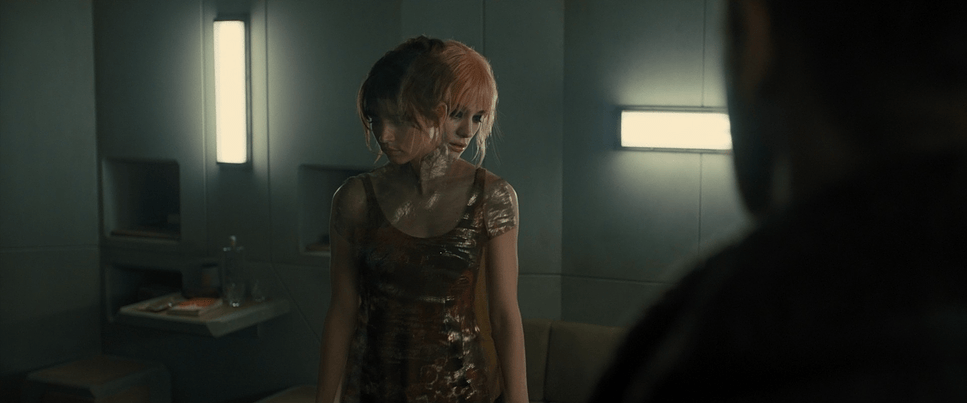
As the narrative progresses, Joi becomes increasingly intelligent and emotionally connected to K. This is most strikingly illustrated when she hires Mariette, a synthetic sex worker, to sleep with him while projecting herself over Mariette’s body. Joi recognizes that neither she nor K can physically touch one another, yet she orchestrates this unsettling arrangement to overcome the biological limits of her existence and offer K a more complete intimacy.
Ultimately, Joi challenges the boundaries of what it means to be alive. The film questions whether love and affection can be entirely programmed, suggesting that in a world of implanted memories and manufactured needs, even love might be engineered.
Crucially, Joi senses K’s growing hope that he is more than just an ordinary replicant. Rather than treating him as another disposable Nexus-9 unit, she nurtures that belief. Most importantly, she gives him a name: “Joe.” For much of the film, K is reduced to a serial number—KD6-3-7. When Joi declares that “a real boy deserves a real name,” she gifts him something the system never could: an authentic identity of his own.
But how much of these feelings is just code, or imagined reciprocity that exists only in the mind of K? If it’s easy to fall into the trap of calling this love, what does that say about what love actually is? Can love merely be coded, with its substance simply filled in over time? Denis Villeneuve pushes audiences to think about what they would value as love. In the final article, we will explore how they interact and behave, how real their relationship truly seems, or whether it is nothing more than a program optimizing its objective.