
Every time I think about how I am going to get all this stuff done between semesters, I actually end up doing nothing but watching movies and learning about the different types of films being made.
Because I can’t handwrite very well anymore, I am always on a laptop, and sometimes I use an iPad. I find that Apple laptops are actually better and more affordable than PC laptops—though there are so many PC makers, and I’m sure there are comparable PC options out there. It really depends on your field of study; I’d imagine PC users lean toward the more tech-heavy side because Windows allows users greater customizability. Even though I already have a MacBook Air, I think I’m going to go check out the MacBook Neo. I don’t know if I really need it, but if it’s going to save me space and weight, it might be a good investment.
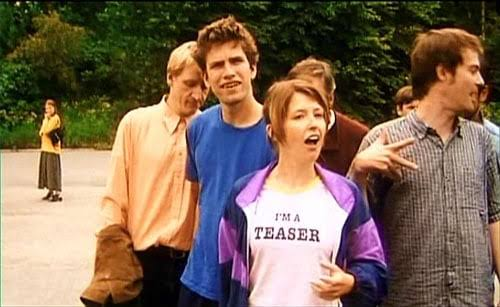
Watching the 1998 movie The Idiots really got me thinking about how politically correct and bourgeois our society is.
The story follows a community of middle-class adults living in a house, led—of course—by a charismatic figure. The group engages in a social experiment, kind of like the ones you see on YouTube where a streamer or videographer creates a scene to film the public’s reaction. (I don’t condone this type of experimentation, by the way, unless it follows proper procedures or is approved by a governing body adhering to standard guidelines.) The group pretends to be developmentally disabled in a way meant to expose how ridiculous society is, serving as a direct provocation against the bourgeois middle and upper-middle classes.
This film premiered at the 1998 Cannes Film Festival and was predictably met with ridicule, disgust, and heavy critique. Because the movie walks a very thin line between exploitation and satire, some critics argued its portrayal of disability felt like “playing tourist”—where the characters could just drop the act whenever they wanted. I can see why people felt that way, worrying the film intentionally exploited disabled individuals for shock value, especially since it was competing for the Palme d’Or.

Directors Lars von Trier and Thomas Vinterberg launched the Dogme 95 movement in Denmark as a radical counter-attack against Hollywood blockbusters. Their goal was to make films focused purely on human behavior, acting, storytelling, and theme. These movies were stripped of artificial elements: natural lighting only, handheld cameras exclusively, real locations, and authentic settings. Superficial actions like murder, high-speed chases, and elaborate stunts were banned, and most importantly, director credits were omitted to kill the ego of the auteur. Dogme 95 was created to “purify” cinema of the technical flash seen in modern blockbusters like Marvel’s The Avengers.
The Idiots followed this strict set of rules. Although it was shot on digital video rather than traditional 35mm film, the rest of the rules were strictly observed, keeping the spirit of Dogme 95 and the authenticity of the filmmaking intact.
Anyway, whoever chose this film to stream on Mubi knew what they were doing. I was kind of confused throughout the movie, though—I didn’t understand why they were doing it, who these people were, how they picked up the stranger at the beginning, or why she stayed with them despite what they were doing. She herself questioned their motives and whether it was wrong of them to pretend to be disabled.
The movie utilizes a filmmaking technique called retrospective narrative coherence (though I’ve also heard it referred to as a puzzle box technique). Whatever you call it, it drops you right into the middle of the story, forcing you to push ahead. It’s not until the very final sequence that all the pieces fall into place, revealing the characters’ emotional choices and bringing the meaning of the film into sharp focus.
It’s Saturday, and I’ve just been sitting on my couch refusing to take out the recycling and green bin, watching movies, reading about film, and writing these reviews. I guess I better go do something now.
Just a reminder this film is not in English and there are subtitles.


