
Saturday night I saw the world premiere of a documentary on dating, called “Love Apptually”. It was a film that touched on a lot of themes, like how does the algorithm work and is an inherent bias for your failure to secure a mate?
The film begins following the French journalist, Judith Duportail, whose journey through Tinder turns out to be fun initially, but by the end it was not rewarding at all. She was left hopeless in love and dating, opting to have children on her own. She said that the messages that she received from guys was very misogynistic and claimed that the algorithm was actually shaped in a way that it was against women.
If you actually look at the evidence that she provided, it was that Tinder had developed what was called an ELO scoring system, the exact workings are still a bit unclear to me, but this is how it works in the general sense: If you were liked, your score went up, if you were disliked your score went down. Seems simple, but here is the part where I need to do more research, if you were an attractive male (attraction is subjective, so there must have been a more complicated way of determining this) and had a good job with a great deal of educational achievement, as a male you were rated higher, and as a female you were rated lower.
However, Tinder itself has moved away from the ELO ranking system, which I can only assume was for the reasons of bias that were repeatedly brought up by various critics. From this, Judith Duportail had discovered information about her own data, where she concludes that the algorithm was against women. This information was obtained from her own data report. obtained from Tinder. Judith Duportail and a lawyer presented a case against Tinder to a judge, which went to trial and she had won, where she was awarded an 800 page document of her own personal data that Tinder had collected. Analyzing this enormous document, page for page, she came back with the loose rules the algorithm uses that takes human desire and quantifies it, and ultimate strengthens gender and racial biases.
My perspective is, that she is looking at data, and not the users who are interacting with this data. All of this information is just her own preferences, her choices, as well as what I would imagine is the choices of users that had also interacted with her. So is it really that Tinder coded for the bias, or is it that Tinder has exposed the biases that exist in our society, within ourselves?
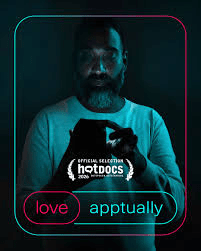
https://www.loveapptually.tv/about
The success rate for men obtaining a match, and females obtaining a match are at polar ends of the spectrum. Men tend to be focused more on volume and women tend to be more selective. This fuels the male 2% success rate vs. a female success rate of 50%. I’ve studied animal behaviour, sexual selection, reproduction and development and even in plants, this is the natural observed phenomenon. It’s not hard to see why males choose in large volumes. whilst women are more choosier.
Male sperm is the abundant, and is relatively cheap to make, whereas the female gamete (the egg) is more costly and in limited supply. These traits are seen throughout most of the species on the planet, which really does make the saying “We are just animals after all,” seem factual. However, I’ve spent a great deal of time studying various aspects of cognition, that to me just seems almost like second nature, we are so different from animals it’s not even close.
Yet, there are people that believe that we are nothing more than animal instincts. I get why they believe this too, like it’s not hard to see something that is so similar to us, and then conclude that we must be the same; especially, if you haven’t been in school, learning and studying for almost your entire life. Communication in animals, as I have learned, takes place in so may different mediums, can be deceptive, or exploited if the message was intended for a specific receiver, but uncovered by an eavesdropper. There was a point in the movie where some lady said that men had forgotten how to read signals, as if we are the same type of animals that are in the wild and we didn’t have this language or way of communicating. Why would you rely on signals when so much can get lost in translation?
Have we not evolved to be superior organisms that can communicate, or do we have to resort to lucrative dances and mental illness (don’t answer that by the way, I’m actually scared of the answer)? Or is it that the ego of women is too shallow, that they secretively depend on men, and feminism has just warped their minds into believing that it is in fact the fragile male ego, the male loneliness epidemic, it seems that feminism is always pointing the finger at everyone else. During the Q&A, director and film maker Shalini Kantayya discussed the role of choices, and how the paradox of choice impacts our decisions.
I can write probably an entire half of a novel about this paradox of choice, how consumers are being faced with an abundance of options, how certain companies are using our “cognitive overload” to guide our behaviour and nudge us to make certain choices. I personally think that this can go either one of two ways, we can be guided to better choices and to make decisions that ultimately better us, or we can be guided to make choices that maximize the profits for a company or in the world of online dating, a large corporation.
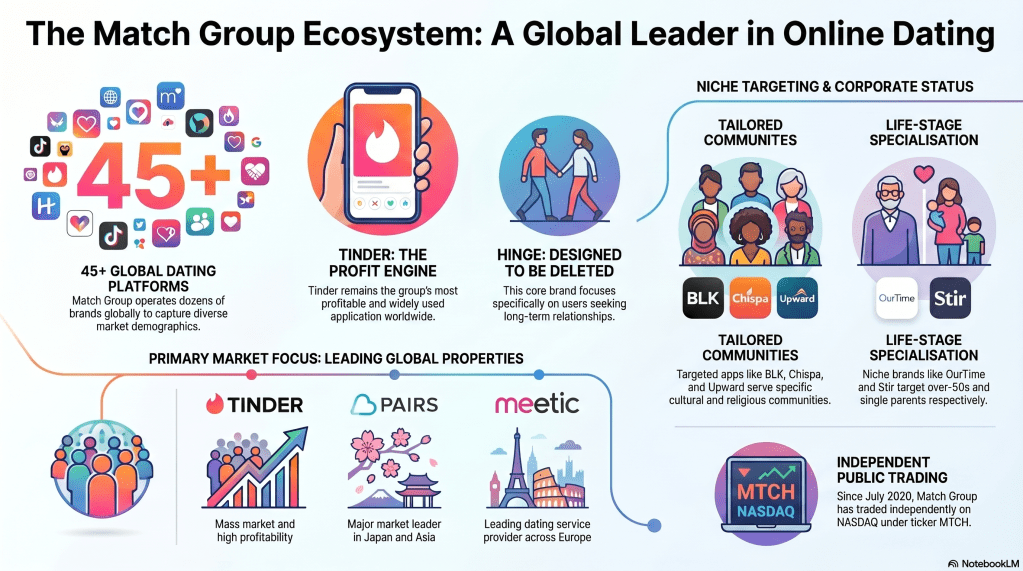
The most striking information to me, was not any of this feminist female propaganda, but this: that two companies, Match Group and Bumble, owned over 90%of the online dating market. Match Group actually owns 61% of the online dating websites, and that is a large chunk of our dating and partner selection for the current generation, especially after the pandemic. These corporations, are essentially the hand of God when it comes to dating, and that is something that I am more curious about, and really, this should be something that everyone should be interested in.
Are we headed towards a future like the one depicted in Idiocracy? I hope not.
References & Sources
Primary Corporate Records
- Match Group, Inc. (2025). Form 10-K: Annual Report for the Fiscal Year Ended December 31, 2025. Filed with the U.S. Securities and Exchange Commission. Available via Match Group Investor Relations.
- Match Group, Inc. (2026, February 3). Match Group Announces Fourth Quarter and Full-Year 2025 Results. Press Release. Link to Official Release.
- Match Group, Inc. (2026). Our Brands: Global Portfolio Overview. Official Brand Portal.
Financial & Industry Analysis
- Barchart.com (2026, April 14). Match Group (MTCH) to Announce First Quarter 2026 Results. Financial News.
- Stock Analysis (2026, April 22). Match Group (MTCH) Company Profile and Brand Segmentation. StockAnalysis.com.
- SEC Exhibit 21.1 (2025). List of Subsidiaries of Match Group, Inc. (Includes Meetic SAS, Plentyoffish Media ULC, and Eureka Inc.).
Major Brands Included in Data (Selection)
- Global Leaders: Tinder, Hinge, Match.com, Meetic, OkCupid, Pairs, Plenty Of Fish.
- Social & Emerging: Azar, Hakuna, The League, Archer (launched 2023).
- Niche Platforms: BLK, Chispa, OurTime, Upward, Stir.


